After the past few posts featuring endangered and unusual species like the Helmeted Honeyeater, Lord Howe Woodhen and Red-tailed Tropicbirds, I’m hoping that no one is disappointed by the return to more a humble species.
At the end of last year I created a calendar featuring birds (surprise surprise). This month’s image is of a White-throated Treecreeper which had flown from a greyish trunk to a tree that had been affected by fire in a controlled burn. I haven’t shared any treecreeper images until today, which is strange because they’re amongst my favourites.
 White-throated Treecreeper (female) (Cormobates leucophaea)
Canon 7D, 100-400mm L IS USM, 1/500, f/5.6, ISO 320, focal length 390mm
The White-throated Treecreeper above is a female, which is easy to tell because of the dab of orange colouring on her cheek. I like the way she landed on the side of the tree, parallel with it, turning her head and standing out against the background blur of Mountain Ash trunks and Prickly Currant-bush. I also photographed her on the other side of the track, on grey trunks that had not been impacted by the burn; the images are bland in comparison, a brownish blob on a greyish trunk. I think the drama of the tree trunk adds interest and I especially like the way the orange bark highlights her cheek patch.
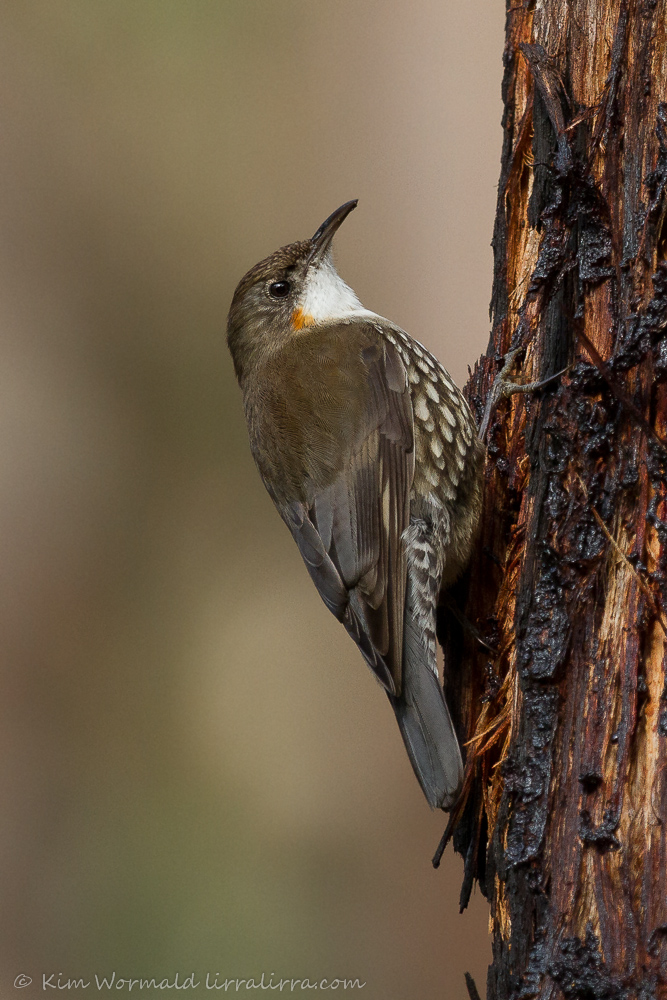 White-throated Treecreeper (female) (Cormobates leucophaea)
Canon 7D, 100-400mm L IS USM, 1/640, f/5.6, ISO 500, focal length 390mm
The pose above is seen more often as treecreepers spiral around tree trunks searching for invertebrates, preferably ants, on and under the bark. Their poses often remind me of woodpeckers but treecreepers don’t tap on trunks or drill holes as they forage.
White-throated Treecreepers are about 15cm long and weigh 22g. They are predominantly dark brown with streaked flanks and a barred under-tail. Their call is a wavering, repetitive piping that can be confused with the clearer tones of the Eastern Yellow Robin’s call. They live in woods and forests between south-eastern South Australia and Queensland. White-throated Treecreepers are rarely seen on the ground, their long toes (as seen in the images above) are perfectly suited for clinging onto tree trunks but not as useful on other surfaces.
I photographed this treecreeper on Singleton Terrace in the Dandenong Ranges when leading Montrose Environmental Group‘s Spring Birdwalk; it has always been one of my favourite birding spots. I was planning another visit but was warned not to as I would be upset by the wide scale clearing along the track and around the ponds. I am upset. The small birds rely on those ponds during the long hot summers and I cannot imagine why their cover has been removed, they will no longer feel safe to drink, the water will evaporate more quickly, and it will be a long time before I am again able to sit hidden amongst the bushes and watch their antics.
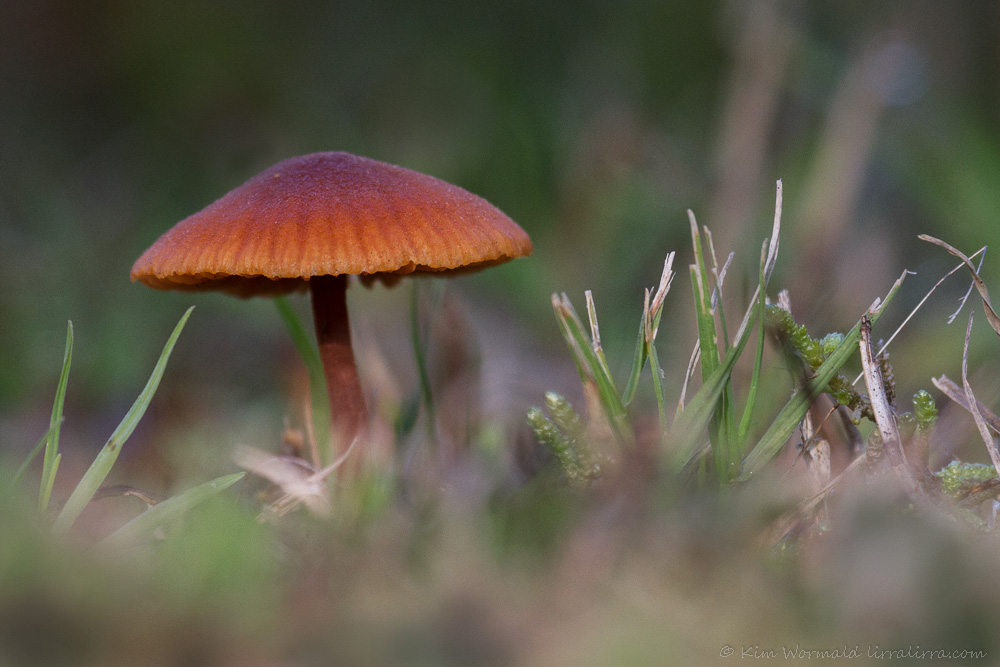 Fungi in a glimmer of sunlight
Canon 7D, 100-400mm, 1/500, f/6.3, ISO 800, focal length 400mm
On slow bird days I photograph all kinds of odd and peculiar things: grass seeds, curled leaves, the moon, helicopters … This week I spotted a tiny fungi nestled amongst the rabbit-nibbled grass. I took a few photos of it, quite a few, without any direct light. Then I noticed tiny dapples of soft light dancing around the area. I was flat on the ground with my finger on the shutter button just in case one of the dapples landed on the fungi – it took about 30 minutes, by which time I was nearly as damp as the grass.
Happy birding, Kim
NB It is now possible to receive a weekly email letting you know that lirralirra has been updated – just add your address to the ‘Subscribe to email’ box above right.
Also, I recently added a Facebook ‘like’ button. Thank you to all ‘likers’ – I like you too!
