For the past couple of weeks I’ve been surrounded by Laughing Kookaburras at home, out walking and today they even turned up when I took a little tacker to the hairdressers – luckily I had my camera with me! Maybe bird photography is an obsession, even as I write I’m watching finches through the window and assessing the lighting.
 Laughing Kookaburra (Dacelo novaeguineae)
Canon 7D, 100-400mm L IS USM, 1/500, f/5.6, ISO 100, focal length 400mm
I was rapt with the beautiful perch that the kooka in the image above chose to land on, the lichen and moss looked lovely in the low morning light, as did the kooka’s feathers and catch-light in its eye. I like its pose as it stares intently at the ground looking for prey. It’s remarkable how far distant a kookaburra can see a likely looking worm, insect or reptile.
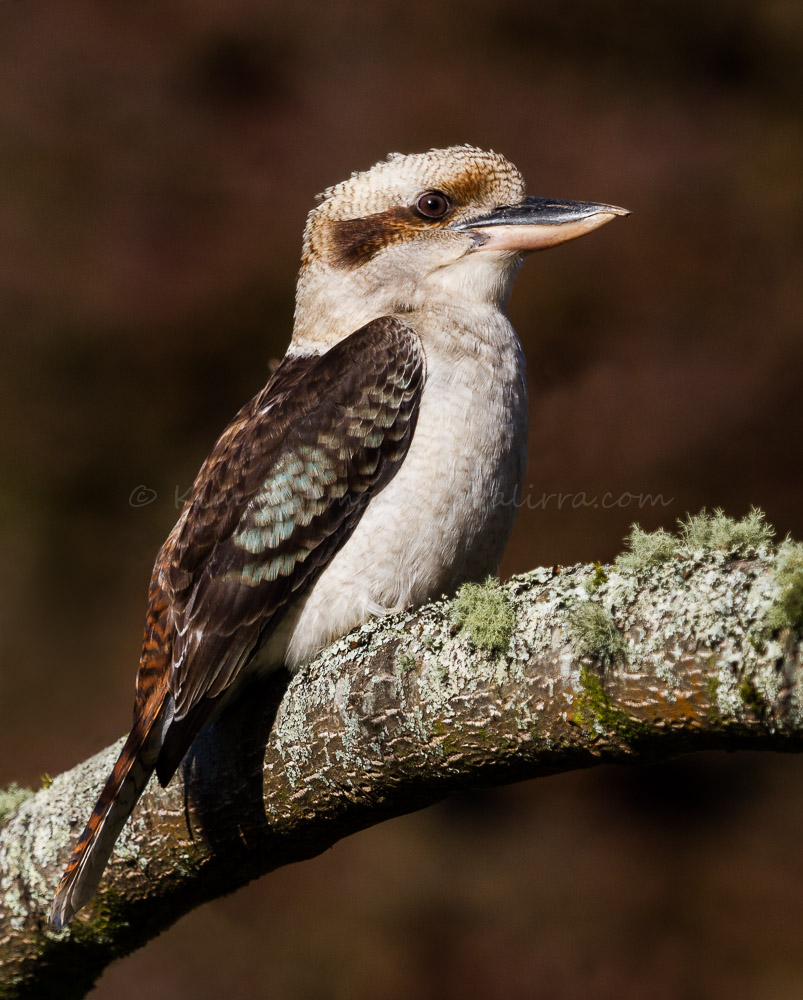 Laughing Kookaburra (Dacelo novaeguinaea)
Canon 7D, 100-400mm L IS USM, 1/500, f/5.6, ISO 100, focal length 400mm
The image above is another typical kookaburra pose, gazing into the distance before lifting its tail, pooping and flying away. They look heavy in flight, as though their heads are too big to allow them to stay in the air. These large kingfishers (about 40cm and 340g) can be confused with Blue-winged Kookaburras although the two species only overlap in Queensland. Blue-winged Kookaburras are slightly smaller with more blue on their wings, blue rumps and strangely pale eyes.
Even if you’ve never seen a Laughing Kookaburra you have almost certainly heard one as their calls have been used in movies for decades including Tarzan and Indiana Jones. Despite being endemic to Australia, Laughing Kookaburras feature in movies set in African and South American jungles, as well as many other unlikely places.
The kookaburras’ call is fantastic, a long maniacal laugh that echoes around you, especially when several birds are calling together. They often call early in the morning and late in the evening, marking their territories by moving from corner to corner and calling loudly. There’s a good recording of a Laughing Kookaburra on BirdNote although the North American voice-over pronounces kookaburra incorrectly, as do my Canadian friends and family. It’s not k-00-kaburra where the ‘oo’ sound rhymes with ‘two’ but what is referred to as a schwa, or unstressed neutral vowel sound, like the ‘a’ at the end of America. Maybe it would help if it was written as ‘k’kaburra’ but then we’d have one less thing ourselves to chuckle about.
Happy birding, Kim
NB It is now possible to receive a weekly email letting you know that lirralirra has been updated – just add your address to the ‘Subscribe to email’ box above right.
Also, I recently added a Facebook ‘like’ button. Thank you to all ‘likers’ – I like you too!
