The Shy Albatross that featured in Pelagic Pain and Pleasure (and again below) has a scientific band on its left leg. Over the past couple of weeks I’ve done some research and thanks to David from the Australian Bird and Bat Banding Scheme in Canberra, and Rachael from the Threatened Species and Marine Section of the DPI in Tasmania I have some fascinating news to share.
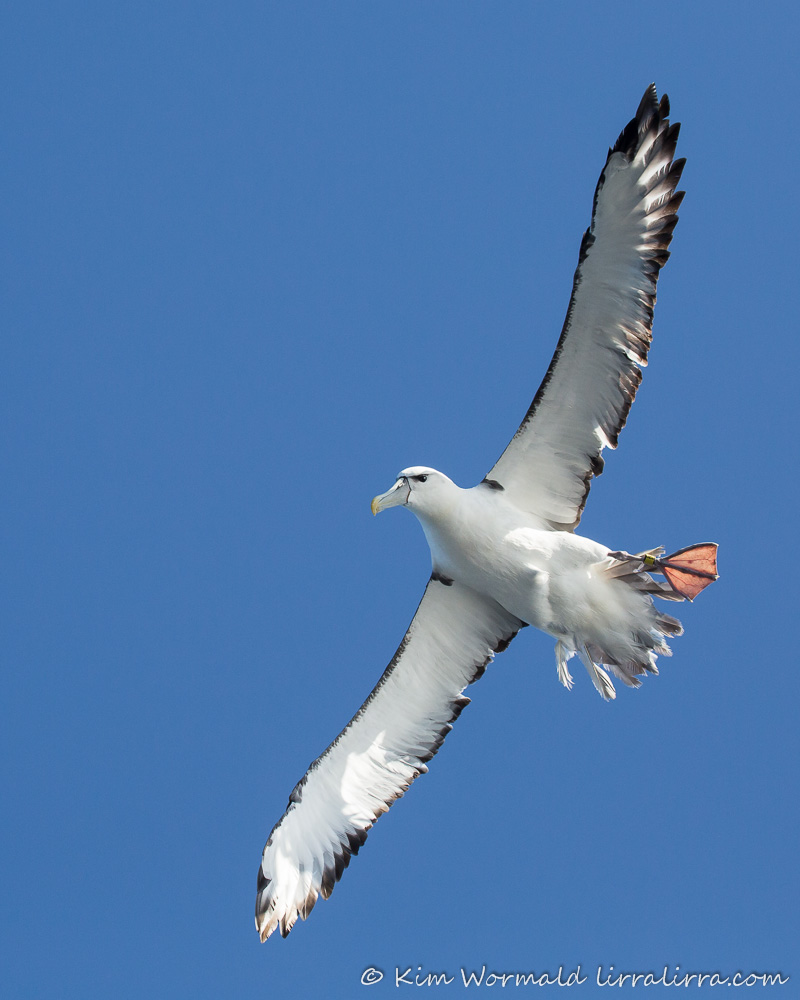 Shy Albatross (Thalassarche cauta) – aka left leg yellow 023
David put me onto Rachel who needed the band number to find out whether the Shy Albatross above had been banded as a chick or an adult. She could tell by the yellow darvic band that it was a bird from Albatross Island and that it had once sported a satellite transmitter. I sent her a close up of an image (below) where the number 023 can clearly be seen. Rachael was thrilled to know it had survived since being banded (by Dr RP Gales) as a nestling, and tracked as part of “The Big Bird Race” in April 2004.
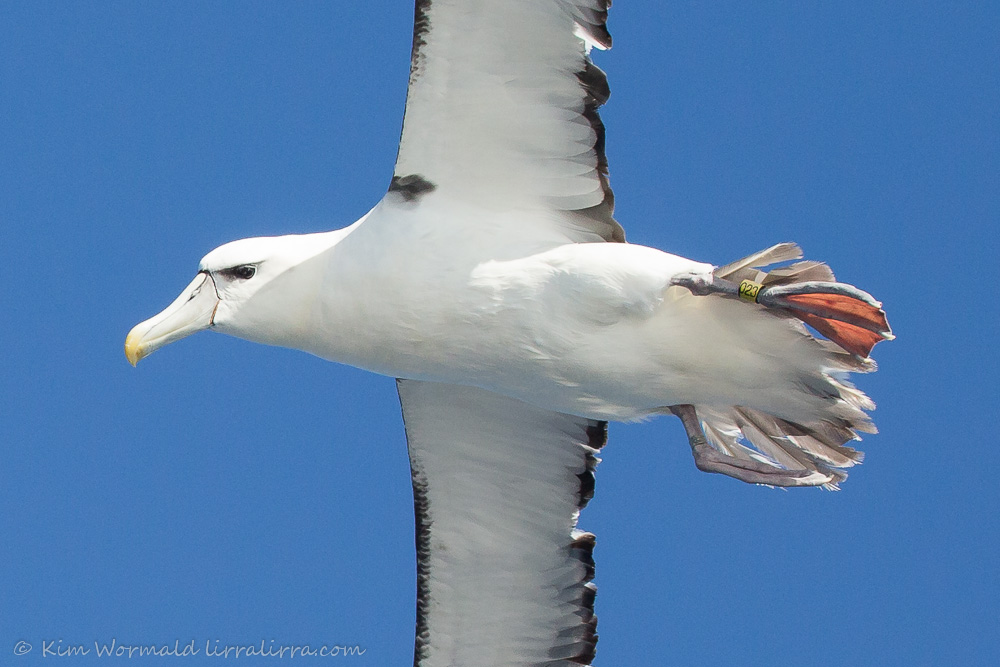 Shy Albatross – Yellow 23
Ten years and ten days had passed since the Shy Albatross was banded and I took my perilous trip to open waters and photographed it. It’s unknown whether it is male or female but they do know that it was 311 km from the banding site when the image above was taken. The albatross was one of only six that was tracked for 60+ days at sea.
Rachael kindly sent me a paper she co-authored, titled Post-fledging survival and dispersal of shy albatross from three breeding colonies in Tasmania by R Alderman, R Gales, AJ Hobday & SG Candy (2010) where it states that albatross are the most threatened bird taxa with many populations in decline, predominantly because of the loss of birds due to commercial fishing; juveniles are particularly vulnerable.
According to the paper, Shy Albatross breed exclusively on three offshore islands around Tasmania. Nestlings were fitted with transmitters in 2004; not all of the birds left the islands but the remains of only one chick were recovered on Albatross Island. Of the 48 birds that were fitted with satellite transmitters on Albatross Island, Mewstone and Pedra Branca a staggering “23 (49%) [were] assumed to have died upon or soon after fledging”. Twenty-five of the birds were tracked for between 10 and 80 days at sea; 10 were from Albatross Island; they travelled at an average speed of 18km per hour. Seven bands from Mewstone chicks were recovered in South African waters while Albatross Island juveniles tended to head for areas around Kangaroo Island and the Eyre Peninsula.
It is remarkable that ‘our’ bird had not been sighted since being banded. Shy Albatross return to the place they hatched when they themselves are ready to breed, this doesn’t happen until they are at least 7 or 8 years of age. Rachael commented that she hopes to see Yellow 023 at the Albatross Island colony in upcoming breeding seasons. I’ll keep in touch with her and will let you know if it turns up, hopefully when it turns up!
 Skua species
There were several species of Shearwater seen on the pelagic trip, if anyone can help ID the bird above I’d be grateful.
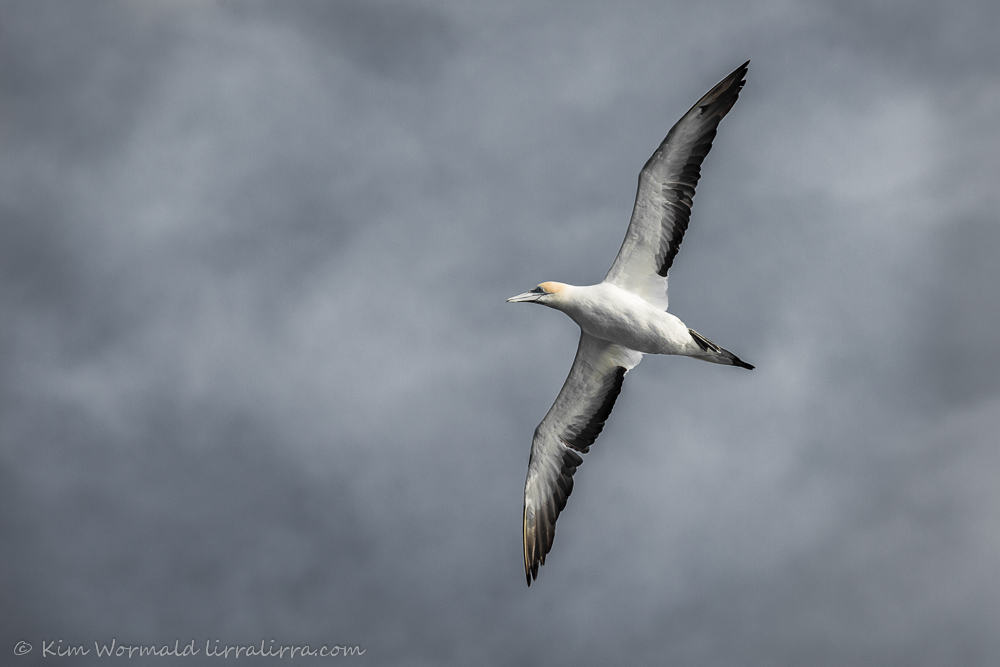 Australasian Gannet
As we headed back to Portland the seas were calmer and I was pleased to be feeling well enough to look at the gannets on and around Lawrence Rocks, 2km south of Portland. None of them came particularly close but it felt good to have my camera in my hands again and I was happy to capture the gannet above as it flew gracefully past the boat.
Happy birding, Kim
Important request from David at ABBBS:
If you find a bird with a band, wing tag, or some other markings, the ABBBS would like to hear about it (abbbs@environment.gov.au or 02 6274 2407) with the following information:
- the band number, where and when you found it, what you think happened to the bird, where the bird and band are now, notes about any other marks on the bird.
If the bird is not alive, the ABBBS would like you, if possible, to:
- remove the band, gently straighten it, stick it to cardboard, write the band number onto the cardboard, mention if you telephoned the ABBBS about the band, send the band to ABBBS at GPO Box 8, Canberra, ACT 2601.
The ABBBS will be very glad to hear from you and will send you a letter telling you where and when the bird was banded.
NB It is possible to receive a weekly email informing you that lirralirra has been updated – just add your address to the ‘Subscribe to email’ box above right.
Also, I have added a Facebook button – thank you ‘likers’, clicking the button is appreciated – sometimes ‘likes’ show up on the home page and sometimes on the post itself.
