A while ago I asked a 5 year old what she’d do if she saw a snake. Her response was hilariously inappropriate, in a loud, dramatic voice she proudly announced “I’d punch it in the head”. So when we were walking together in the bush last week I made sure that the now 6 year old knew more appropriate strategies, which was just as well as within minutes we came face to face with a Red-bellied Black Snake sunning itself on a bank. Later in the week I met the Tiger Snake pictured at the end of this post.
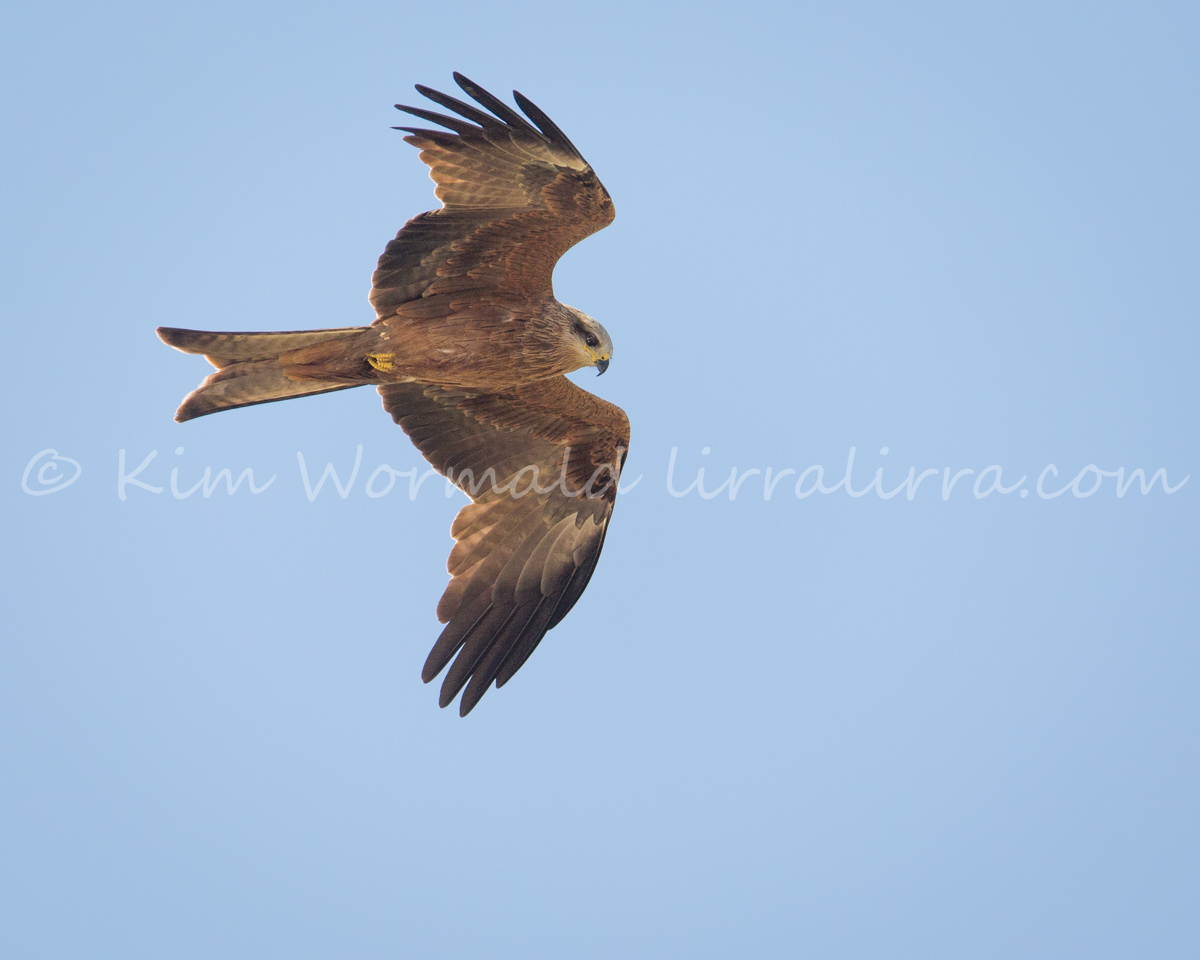
 Black Kite (Milvus migrans)
Canon 5DIII, 1/1600, f/6.3, ISO 800
Black Kites are easily identified by their forked tails; I have taken numerous photographs of them in flight. Sometimes they are so far away that all I capture is a barely identifiable smudge, at other times they are closer and I clip a wing, or closer still and all I’m left with is the tip of a tail in a sea of blue. This session was different and I managed to capture shots with clarity, eye-shine and a little rim lighting evident on the tail feathers and flight feathers. The image shows details of its underparts, dark eye, yellow cere, yellow feet, black bill and the three levels of coverts scalloped along its wings.
The image was taken mid-afternoon when the sun was fairly high, but the kite was flying low and light was reflecting from the stony ground onto its underside.
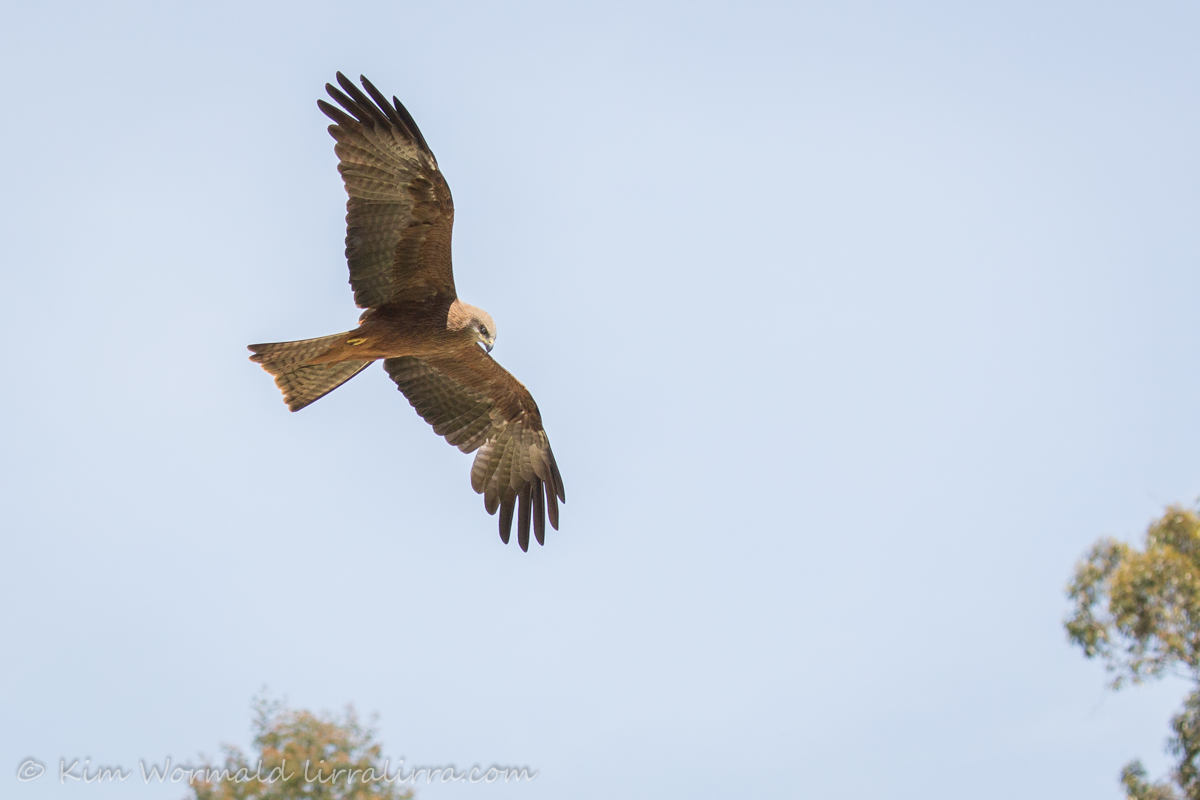
Black Kite (Milvus migrans)
Canon 5DIII, 1/2000, f/6.3, ISO 800
Black Kites don’t always make their forked tails obvious in flight, sometimes you have to watch them for a while. The image above was taken a little earlier in the day of a different kite. The barring on its flight feathers and tail is clear.
Small groups of Black Kites are commonly seen at the Western Treatment Plant and the species is common across most parts of mainland Australia. They are often seen following harvesting-machinery and at the edge of fires, where they search for disturbed insects and small mammals. During locust/grasshopper plagues Black Kites congregate in flocks of several thousand birds, no other raptor shares this communal behaviour.

Tiger Snake (Notechis scutatis)
Canon 5DIII, 1/2500, f/5.6 ISO 400
Tiger Snakes are common at the Western Treatment Plant and part of the conditions of entry include wearing long trousers; if I was walking through grassy areas on a sunny morning I would probably wear my oilskin gaiters to give added protection. I was out of the vehicle, photographing a Black-shouldered Kite when I saw the little beauty above enjoying the warmth of the road not far from where we were standing. It wasn’t keen to be watched and moved like lightening into some low vegetation and gravelly rocks. Luckily I had the camera set for birds in flight and I managed to capture this image of the snake as it raced away with its forked tongue at full stretch.
Tiger Snakes are the fourth most venomous snake in Australia. They grow to about 1.5m and are variable in appearance, some have much bolder ‘tiger stripes’ than others. Tiger Snakes are viviparous and give birth to 30 or more live young, up to 70 young have been recorded. The vast majority, approximately 95%, of snakes bites are suffered when someone is trying to catch or kill a snake. It’s far better to look before you step, particularly over logs and rocks, and to back away slowly or stand perfectly still if you see a snake – as the little 6 year old now says “You should stand still because snakes don’t bite trees”.
Happy snake-free birding, unless you’re like me and you like seeing them (at a safe distance),
Kim
~ Thank you for visiting and commenting
~ If you would like a weekly email letting you know that lirralirra has been updated please use the ‘subscribe’ box above right