Werribee Western Treatment Plant was swarming with raptors, waders, water birds and bush birds enjoying the clear blue skies and gentle breeze. The conditions were perfect for bird photography but my Canon 7D and 100-400mm L IS USM intensified the issues I’ve been having with auto-focusing and virtually every image was out of focus and noisy with washed-out colours.
The only images that were acceptable were the final images of the day of an adult and juvenile Black-shouldered Kite.
 Black-shouldered Kite ( Elanus Axillaris) – juvenile
Canon 7D, 100-400mm L IS USM, 1/1000, f/6.3, ISO 100, focal length 390mm
Young Black-shouldered Kites have brownish eyes and are predominantly rufous on their heads, necks, breasts and backs. The remnants of this colouring can be seen on its breast and in the striations on its head as it gradually develops the bright white plumage and red eyes of the adult.
This striking bird was hiding near the top of tree and this twig-infested image was the clearest view I could get. With Photoshop I’d be able to remove the most distracting twigs, I tried removing them with Lightroom’s spot removal tool but made splodges that were worse than the twigs. At least it gives a true representation of the bird’s environment!
 Black-shouldered Kite
Canon 7D, 100-400mm L IS USM, 1/1250, f/6.3, ISO 100, 390mm
The above image gives a clearer view of the striations on its head. Young Black-shouldered Kites are able to feed themselves within a week which is especially remarkable as I sit here listening to a magpie still clamouring for food despite being out of the nest for just over two months.
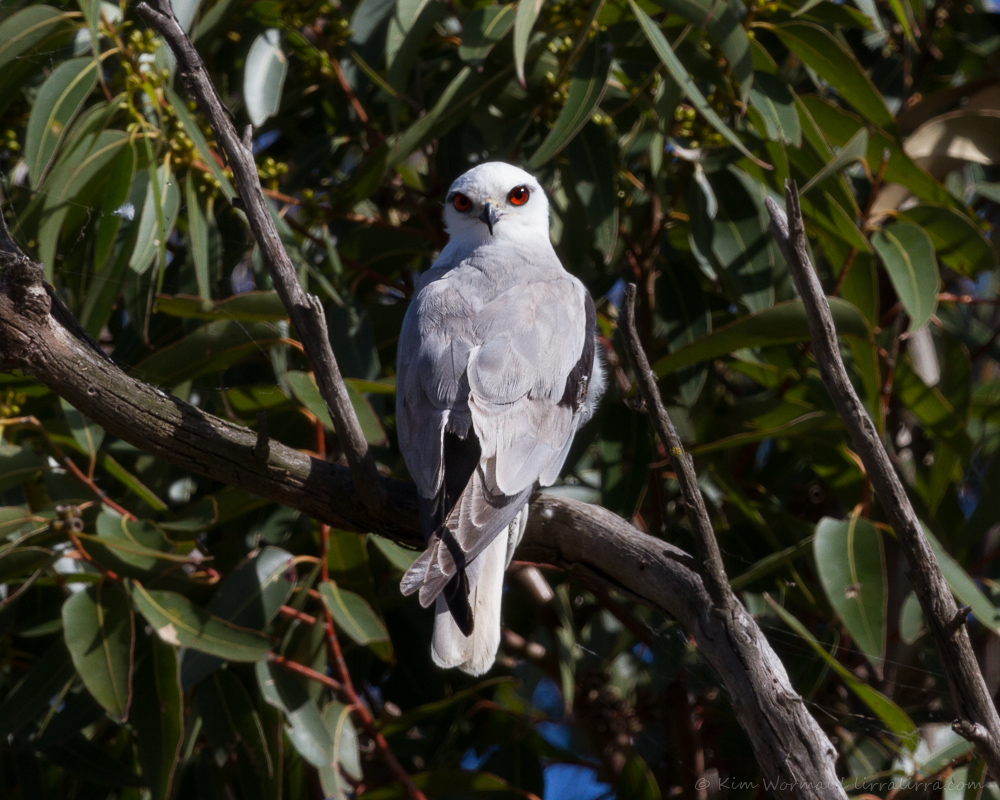 Black-shouldered Kite – adult
Canon 7D, 100-400mm L IS USM, 1/800, f/5.6, ISO 100, focal length 400mm
This adult Black-shouldered Kite has a grey back and red eyes and looks as though it’s something out of the Exorcist (not that I was ever brave enough to watch it). Kites and other raptors, including owls, have loosely connected vertebrae in their necks that enable them to look all around without changing their position on the perch. What I think looks like a bullet hole is just visible in the lower section of its black shoulder: the next image shows the area more clearly.
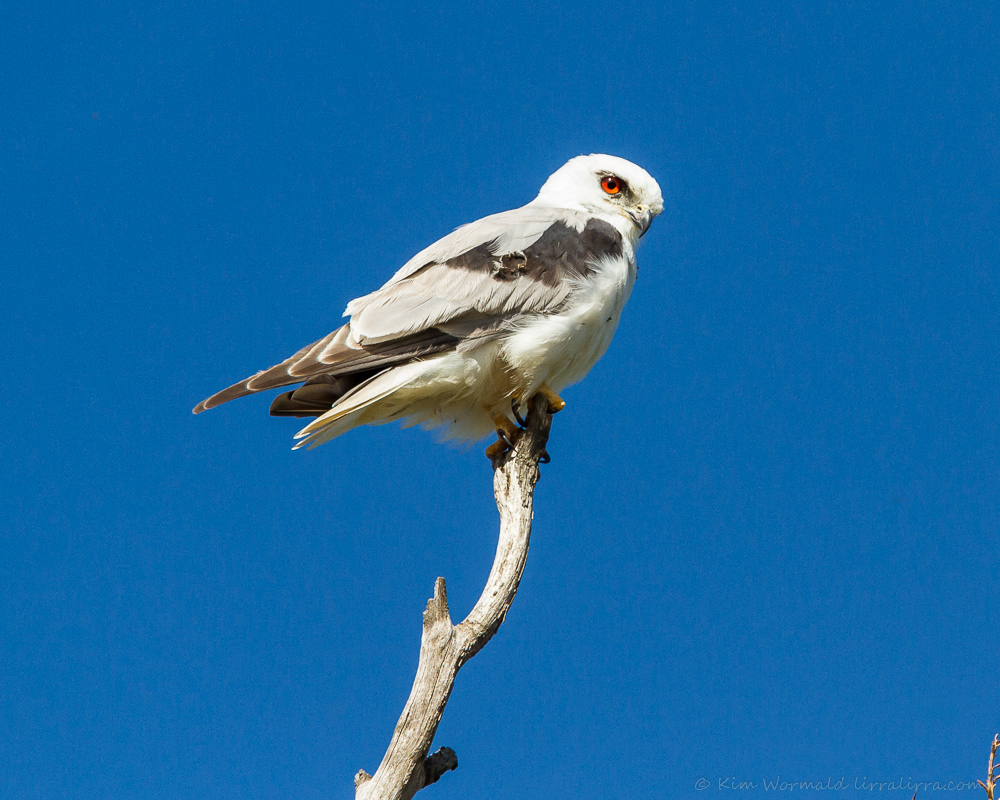 Black-shouldered Kite
Canon 7D, 100-400mm L IS USM, 1/1000, f/7.1, ISO 400, focal length 380mm
The circle amongst the feathers on this bird’s wing made me wonder if it had been shot in flight. I phoned the treatment plant and found that no shooting incidents had been reported. I’ve never seen anything like it before. Is it just a circle of feathers? Was my phone call to the plant more embarrassing than I realised at the time?
Images of a Brown Falcon, Collared Sparrowhawk and Brown Goshawk are posted in Eastern Yellow Robin for Lunch. You might also be interested in Tawny Frogmouth close-ups and Kookaburra sits in the old gum tree.
I’m curious about which camera settings wildlife photographers find most useful – if you’re happy to share what works for you please let me know via email or by posting a comment.
Happy birding, Kim
