Bushfire had ravaged Crows Nest National Park just a few days before I followed this Australian Brush-turkey around as it foraged amongst the ash.
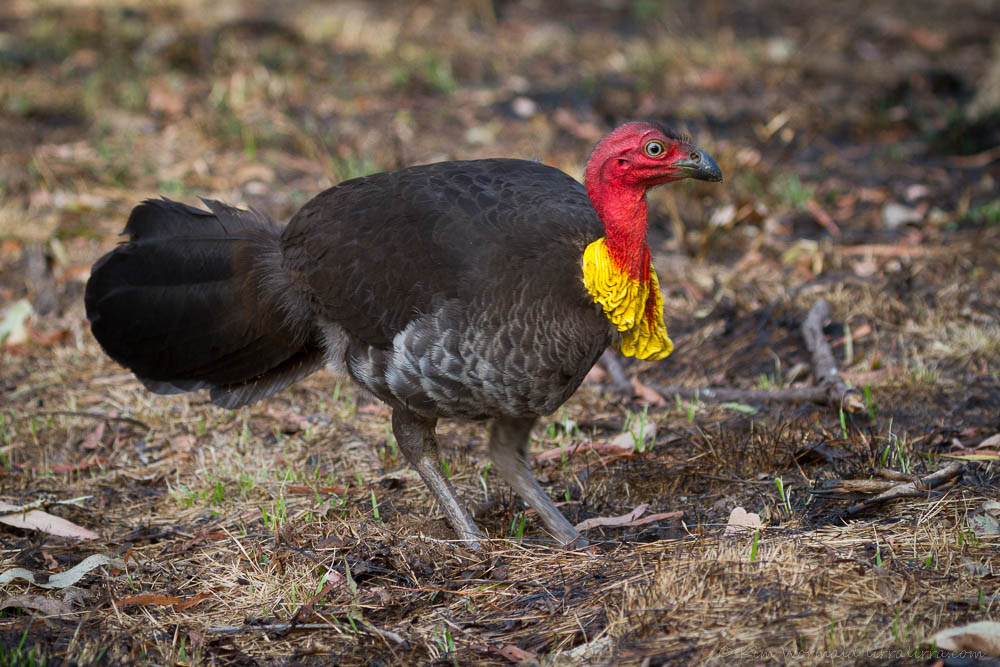 Australian Brush-turkey (Alectura lathami)
Canon 7D, 100-400mm L IS USM, 1/200, f/5.0, ISO 500, focal length 115mm
This odd looking megapode had a remarkable start in life. It hatched from an egg that weighed 12% of its mother’s weight. It was snuggled in a large mound of organic matter built by its father and containing about 50 eggs laid by several different females. Its gender depended on the temperature in the mound while the egg was developing. The father attempted to keep the mound at about 33-38 degrees Celsius which he did by digging into the mound and checking the temperature by poking his bill into the compost. He added more organic matter if the temperature was low, and removed some if the temperature was high. More eggs develop as male if the temperature is low. Each egg has a large yolk which enabled the chick to be very well developed when it hatched. It wasn’t a helpless, featherless, scrawny, pink-skinned hatchling when it dug its way out of the mound but a strong, well feathered chick that could fly within hours.
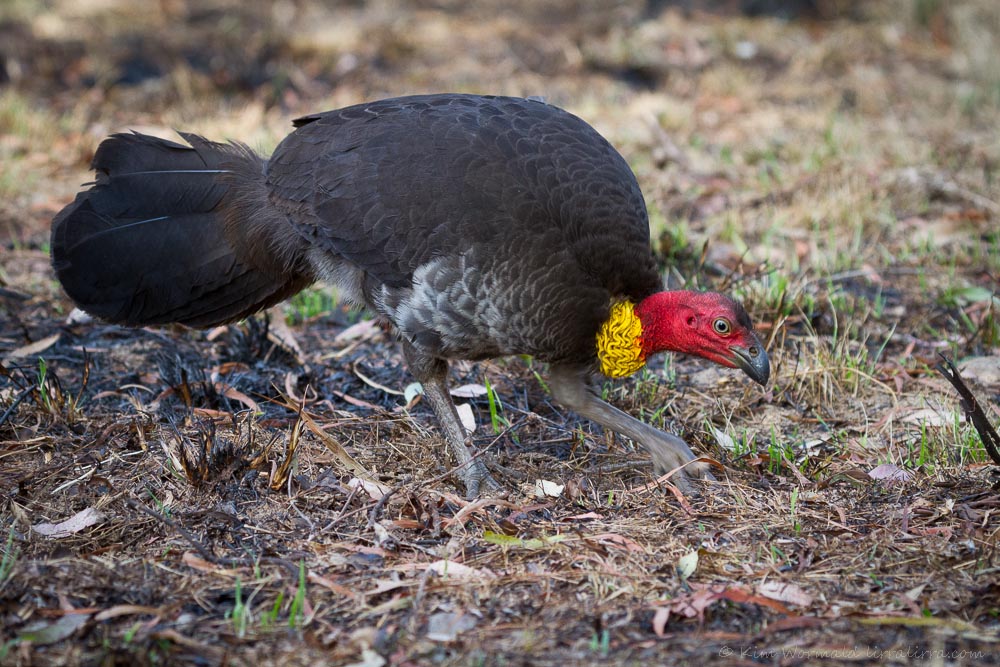 Australian Brush-turkey (Alectura lathami)
Canon 7D, 100-400mm L IS USM, 1/250, f/6.3, ISO 1250, focal length 150mm
The turkey raked vigorously at the ground in search of invertebrates and seeds. My shutter speed was not fast enough in the image above to freeze the movement of its leg. Evidence of the bushfire can be seen along with new shoots that are already emerging. Bushfires have a devastating impact on Australian wildlife, people often talk about how quickly the bush regenerates but it takes far longer for fauna to reestablish itself.
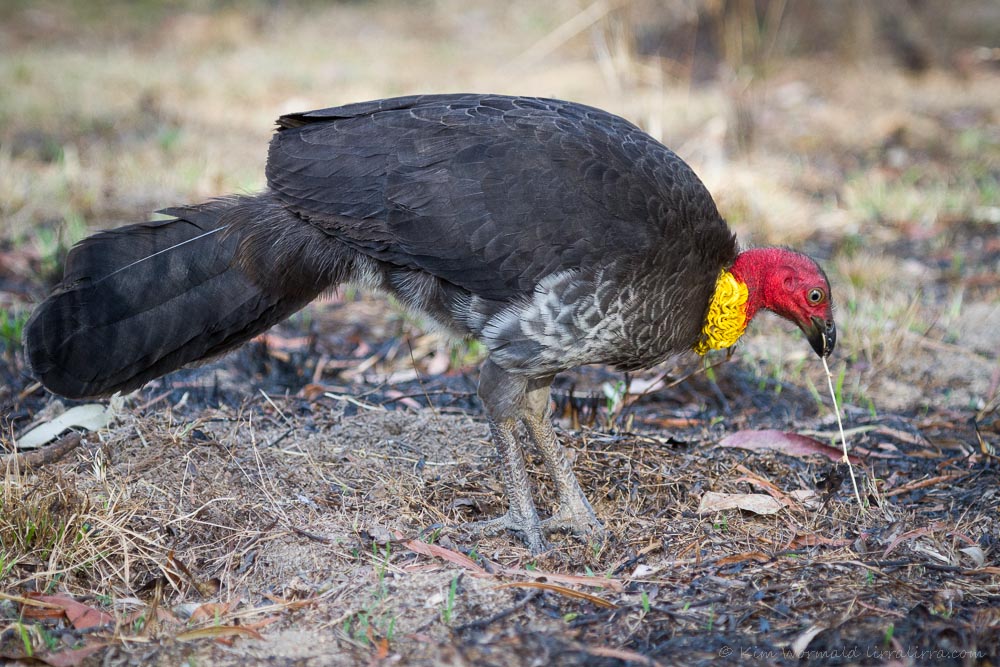 Australian Brush-turkey (Alectura lathami)
Canon 7D, 100-400mm L IS USM, 1/320, f/5.0, ISO 1250, focal length 170mm
It took the turkey quite a few tugs to pull this shoot from the ground. I like the scalloped edges of the turkey’s feathers and the way its tail is held laterally. The bare red skin of its head and the saggy yellow throat wattle are striking features of this bird that is 70cm long and weighs over 2 kilograms.
 Australian Brush-turkey (Alectura lathami)
Canon 7D, 100-400mm L IS USM, 1/250, f/5.0, ISO 1000, focal length 170mm
The image above is a close up of the turkey’s huge foot as it rakes through the ashes of the bushfire; it looks reptilian.
Looking at the camera settings, shooting in aperture priority with no exposure compensation, I’m puzzled by the slow speeds despite the varying ISO and wide open aperture. If you can explain what was happening please let me know, either via comments (below) or email (see contact page).
After having had images stolen I am experimenting with slightly lower resolution images this week but expect to return to higher resolution images next week.
If you are one of the readers who is concerned about the annual Australian harvesting of hundreds of thousands of Short-tailed Shearwater chicks (see Short-tailed bundle of fluff) please contact RSPCA Tasmania to ask about a campaign: rspca@rspcatas.org.au NB the Tasmanian Parks & Wildlife link in last week’s post details how to catch and kill chicks, including methods that are not condoned but are used, please do not access the link if you will find it upsetting – not everyone needs to know the gory details to know that chick harvesting is inappropriate in the 21st century.
Happy birding, Kim
