What a great trip! I loved Lord Howe Island. Loved the hikes, the sunshine, the rain, the rainbows, the clouds, the stars, the people, the coral reef, the fish, the spiders and above all I loved the birds – especially the Red-tailed Tropicbirds.
I hiked up to Malabar Hill three times during our nine days on the island and it’s the part of the island that I miss the most. The experience was enhanced enormously by David Burren’s help, encouragement and company. David is a professional photographer who runs workshops in Australia and overseas (there’s a link to his website on the links page). Two of his images set the scene for the photographs that follow:
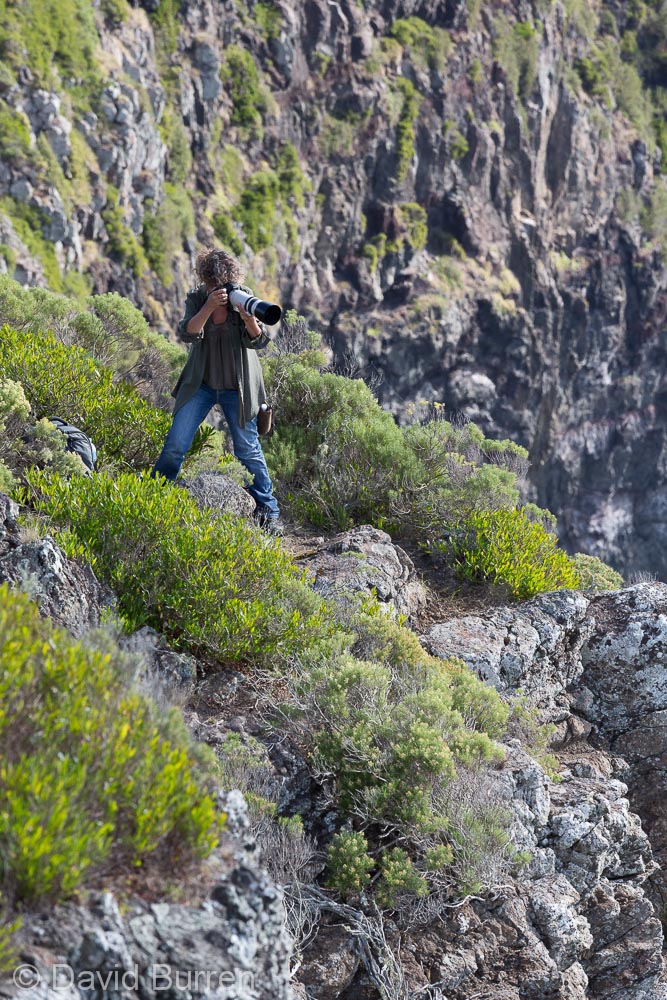 Kim on Malabar Hill
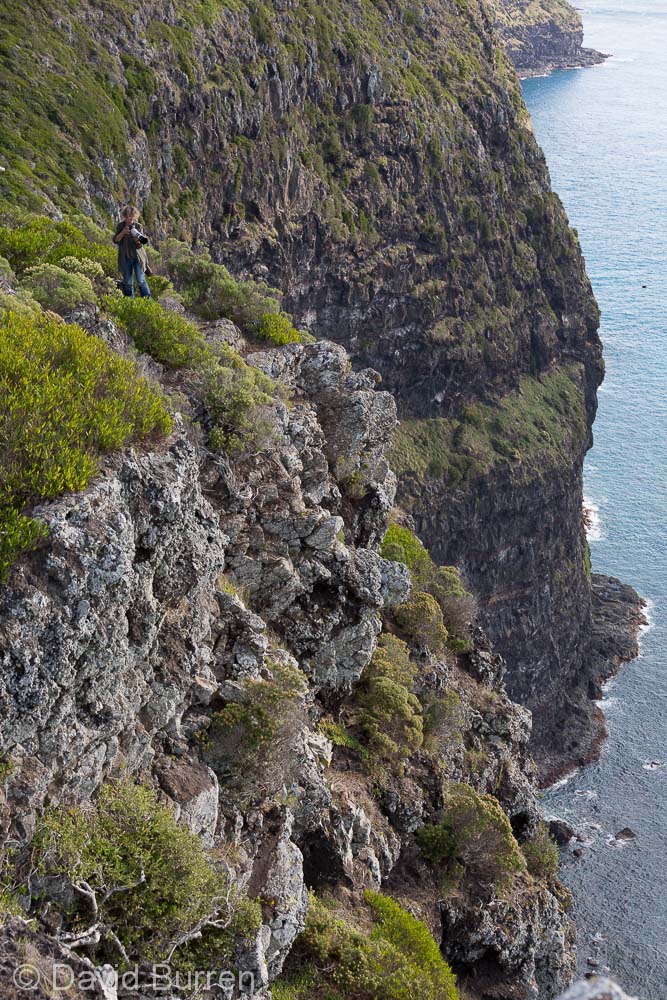 Kim on Malabar Hill – eeek, did I really stand that close to the edge of a 200m cliff face!
Red-tailed Tropicbirds are mesmerising to watch in flight, they move quickly and gracefully, and several times I was so entranced by their beauty I forgot to press the shutter button. I’m glad there were plenty of other times when I remembered.
 Red-tailed Tropicbird (Phaethon rubricauda)
Canon 7D, 100-400mm L IS USM, 1/640, f/6.3, +1/3, ISO 100, focal length 200mm
I particularly like the way the bird is posing in the image above and I like the way blue sky surrounds it as though the clouds have been carefully painted on after the image was taken, including behind the tail streamer to make sure that it is highlighted. Ordinarily I would not favour an image with this kind of head angle but this is one of my favourites, to my mind the head angle suits the pose perfectly.
We spent so long with the tropicbirds that we started recognising and naming individual birds including long tail, two tails, poor old manky foot and seagull (who had no tail streamers). Red-tailed Tropicbirds are 75-95cm long, including their streamers, with a wingspan of about one metre. Juveniles have black bars on their backs, no streamers, and their bills begin black before turning yellow then red. We saw a few birds with two tail streamers but more often we could only discern one streamer.
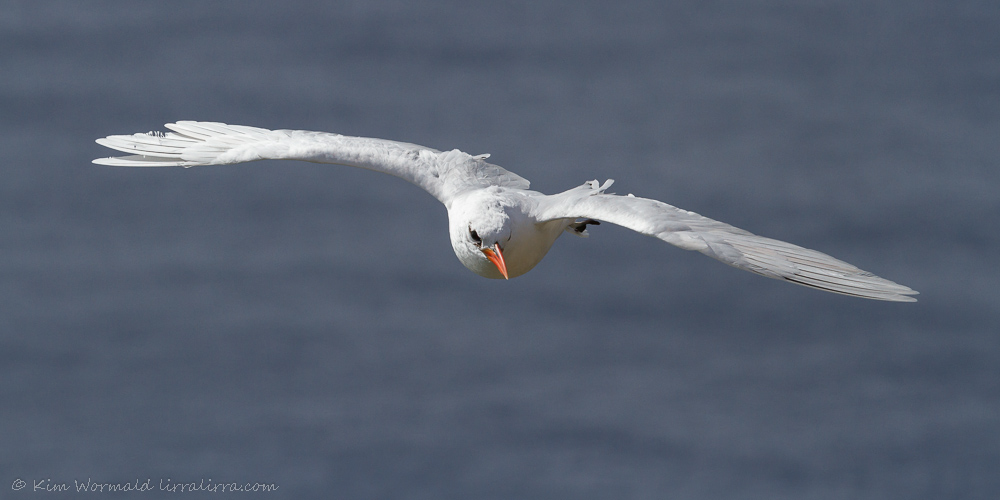 Red-tailed Tropicbird (Phaethon rubricauda)
Canon 7D, 100-400 L IS USM, 1/2000, f/8.0, ISO 400, focal length 235mm
Red-tailed Tropicbirds are listed as vulnerable in NSW and are rarely seen as they spend most of their time at sea and breed high on cliff faces, predominantly on Lord Howe, Norfolk and Christmas Islands. When we were watching the tropicbirds we were more likely to be looking down on them from clifftops or up at them from a beach or boat. I was delighted to see some virtually eye to eye, and thrilled when one flew over me so low that I felt I could have touched it.
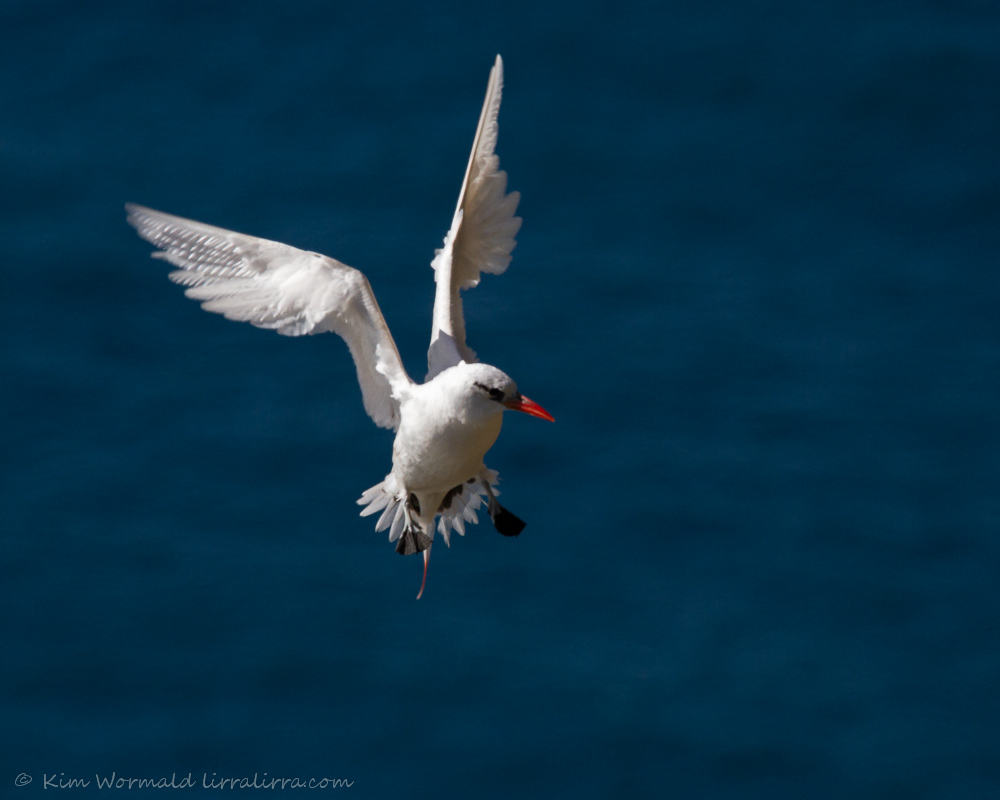 Red-tailed Tropicbird – (Phaethon rubricauda)
Canon 7D, 100-400mm L IS USM, 1/2500, f/7.1, ISO 400, focal length 400mm
Despite a shutter speed of 1/2500 of a second the bird’s feathers are not frozen in the above image. This bird was rapidly moving its wings to hold its position while it looked towards a tiny cave in the rock wall. During the breeding season tropicbirds lay one egg directly onto rock.
Red-tailed Tropicbirds are generally silent at sea but these birds often called to each other as they swooped by. The end of their tail streamers were often whitish which made me think that the bird in the image above is just growing its streamers. Some birds with short streamers did not have a whitish tip and I wonder if they’d been damaged by fish, rocks or coral.
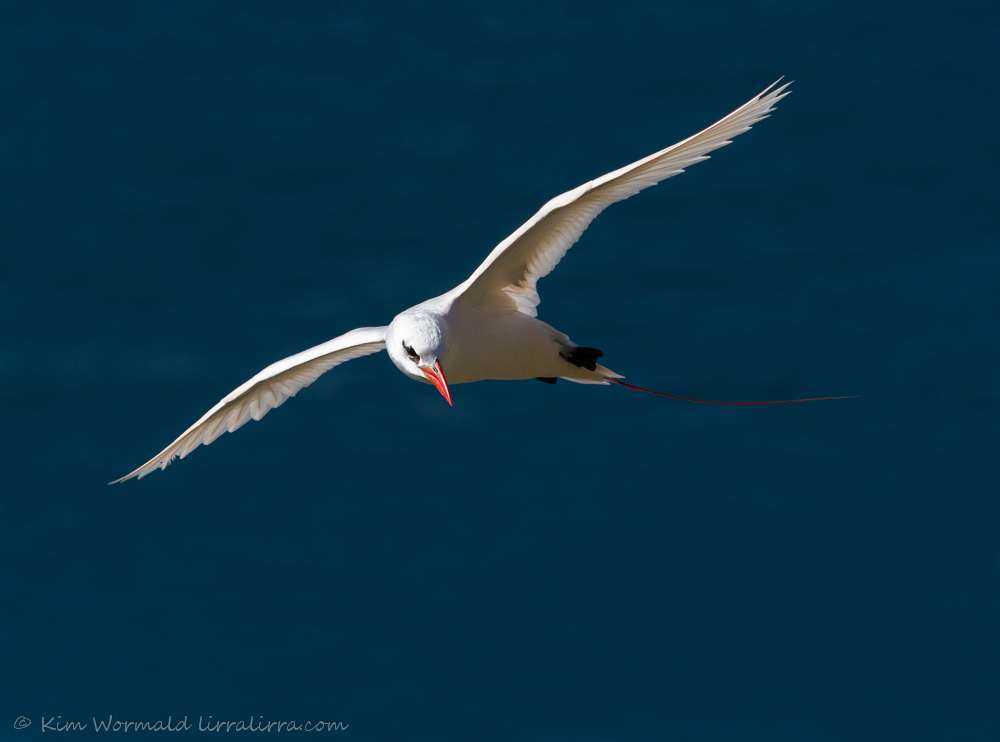 Red-tailed Tropicbird (Phaethon rubricauda)
Canon 7D, 100-400mm L IS USM, 1/2500, f/7.1, ISO 400, focal length 260mm
I was happy to get a catchlight in the tropicbird’s eye in the image above and I love the graceful pose with the long sweeping tail streamer. From the damage to the tip of the bird’s primary feathers on its right wing I think it’s the same bird as the one in the fourth image. This is especially interesting as it makes me wonder where it was hiding its streamer – the scallywag!
In my late teens I was onboard a ship going through the Panama Canal when I saw a tropicbird lit up by the soft deck lights at 5am one morning. Since that morning I have longed to see them again and I’m rapt to have finally spent time with these graceful, angelic birds.
Happy birding and magical memories,
Kim
