A glorious sunrise, a high tide on the turn and vulnerable Hooded Plovers working their way towards me as they forage – does birding get any better?
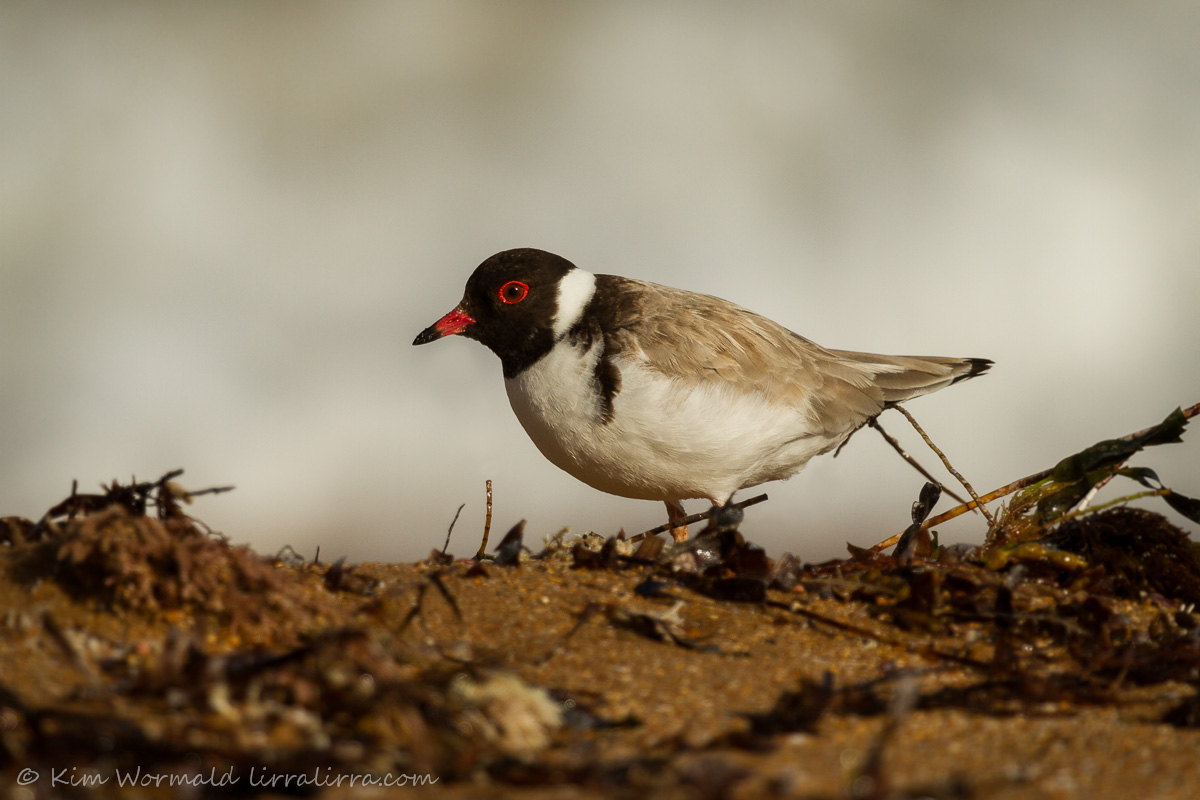 Hooded Plover (Thinornis rubricollis)
Canon 7D, 100-400mm L IS USM, 1/1250, f/5.6, ISO 100, focal length 400mm
Hooded Plovers, or hoodies as they are affectionately known, are about 21cm long with an average weight of 95g and, being so small, they can be tricky to spot on a large expanse of beach. Sometimes I’m sure other beach users wonder what on earth I’m looking at, or assume I’m crazily photographing seaweed with a long lens. Hoodies forage for invertebrates amongst seaweed at the water’s edge as well as on dry sand and in rock pools. They are fun to watch as they bob their heads and pause for brief moments before running like the wind along the beach.
I kept as low as possible while shooting and in the image above it almost seems that I am looking up at the bird. I particularly like the wave breaking in the background as it enables the hoody to stand out more clearly than it would if it was camouflaged against the foreground. Adult hoodies have a black head with a black collar that extends onto the breast, they have a white nape and underparts, a sandy brown back, red eyerings, pink legs and a red bill with a black tip. It fascinates me that such bold colouring is such brilliant camouflage. It works on the principle of disruptive colouration which effectively breaks up the outline of the bird.
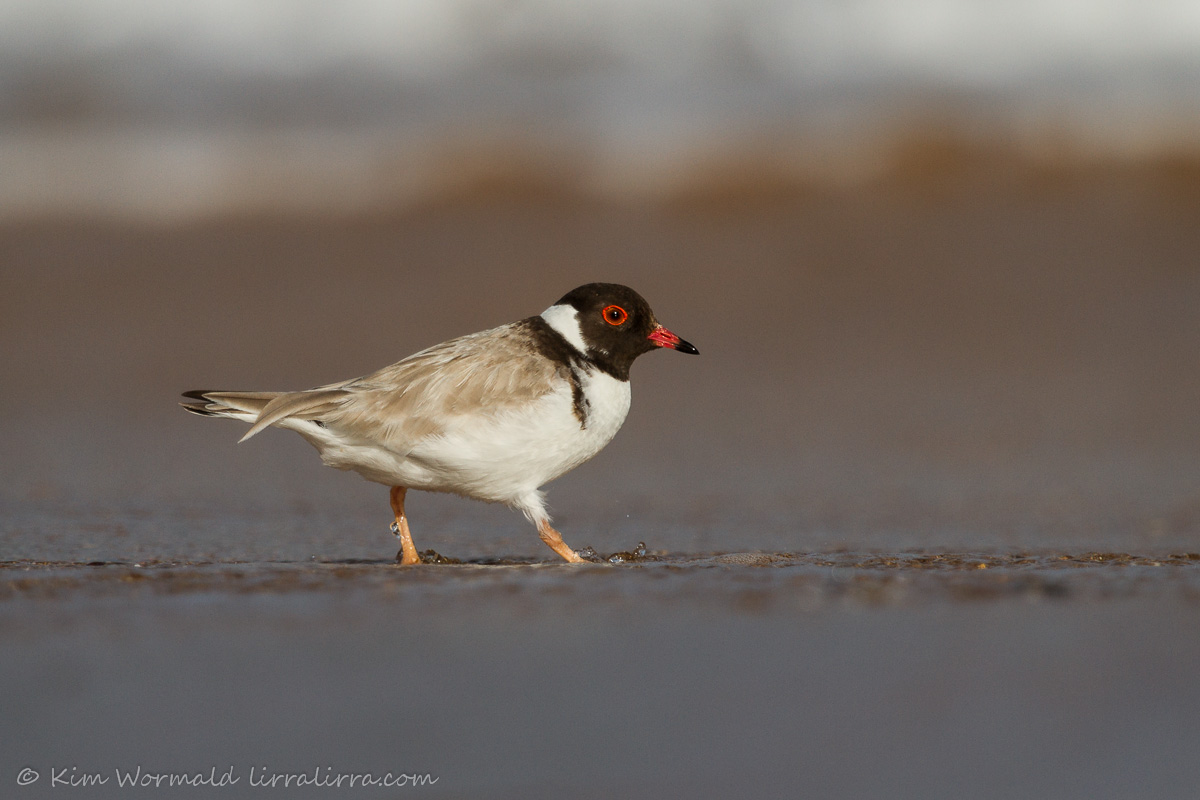 Hooded Plover
Canon 7D, 100-400mm L IS USM, 1/1600, f/5.6, ISO 100, focal length 400mm
I was stoked to see hoodies in lighting that was good for photography and hoped to get some images that were good enough to share. I was thrilled to see the image above emerge from the morning’s efforts. This hoody was foraging on wet sand, dancing back and forth to the music of the waves. With an f-stop of 5.6 making the aperture as widely open as possible I was able to keep the shutter speed high enough for these fast-moving birds. In the above image this also meant that bubbles around the bird’s legs are nicely focused. Choosing a low f-stop creates a shallow depth of field which is very obvious in this image with the wet sand in front of and behind the bird being out of focus along with the breaking wave in the background. A blurred background, bokeh, helps to ensure that the bird itself stands out in an image, rather than being lost amongst its environment.
 Hooded Plover – “Tailwind”
Canon 7D, 100-400mm L IS USM, 1/1000, f/5.6, ISO 100, focal length 400mm
I watched four Hooded Plovers on the beach that morning, three were banded and one was unbanded. Due to their vulnerble status the birds are monitored carefully and measures are taken to help ensure their safety and to provide support during breeding. Their nests and chicks are highly vulnerable for the nine weeks that it takes for the eggs to be incubated and the young birds to be able to fly. During this time eggs and chicks are at risk from raptors, ravens, magpies, gulls, reptiles, cats, foxes and unusually high tides.
Unfortunately Hooded Plovers nest on beaches during summer which means the risks also include increased human and dog activity. People walking, jogging, playing, fishing, sunbathing or walking their dogs may be unaware of the hoodies but their impact can be catastrophic. When facing dangers adult birds stash their chicks on the beach where they freeze until the adults signal the all-clear. On hot days this means chicks can dehydrate, if threats continue throughout the day the chicks can starve. Parent hoodies do not feed their chicks but do their best to keep them safe while they forage for themselves. Where possible rangers and volunteers erect fencing and informative signage to alert beach users to the presence of hoody nests. Councils may also restrict access to dogs during the hoody breeding season, either with signs saying ‘No dogs beyond this point’ or with bylaws stating that dogs should be kept leashed on specific beaches. While this irritates some dog owners I’m sure most of them would willingly use a different beach if they realised that a tiny, endangered chick could be ‘frozen’ on the sand and unable to fly to safety; it would be possible to stand on one without even knowing.
A shutter speed of one thousandth of a second was used for the image above but was still not fast enough to freeze the hoody’s right leg as it sped across the sand, or the sand grains blowing in the wind. I’m curious about which of these images is most liked, if you’ve got a moment I’d appreciate hearing your thoughts – and besides, I really like these images and the memories they bring of a moment of contentment on a difficult day and I’d like them to get enough comments to make it to the favourites’ list.
Wishing you a 2014 filled with happy birding, Kim
NB It is possible to receive a weekly email letting you know that lirralirra has been updated – just add your address to the ‘Subscribe to email’ box above right.
Thank you to all ‘Facebook likers’ – it’s lovely to know that you enjoyed the post.
