A pair of Whistling Kites were playing catch with a bone – it was fascinating to watch.
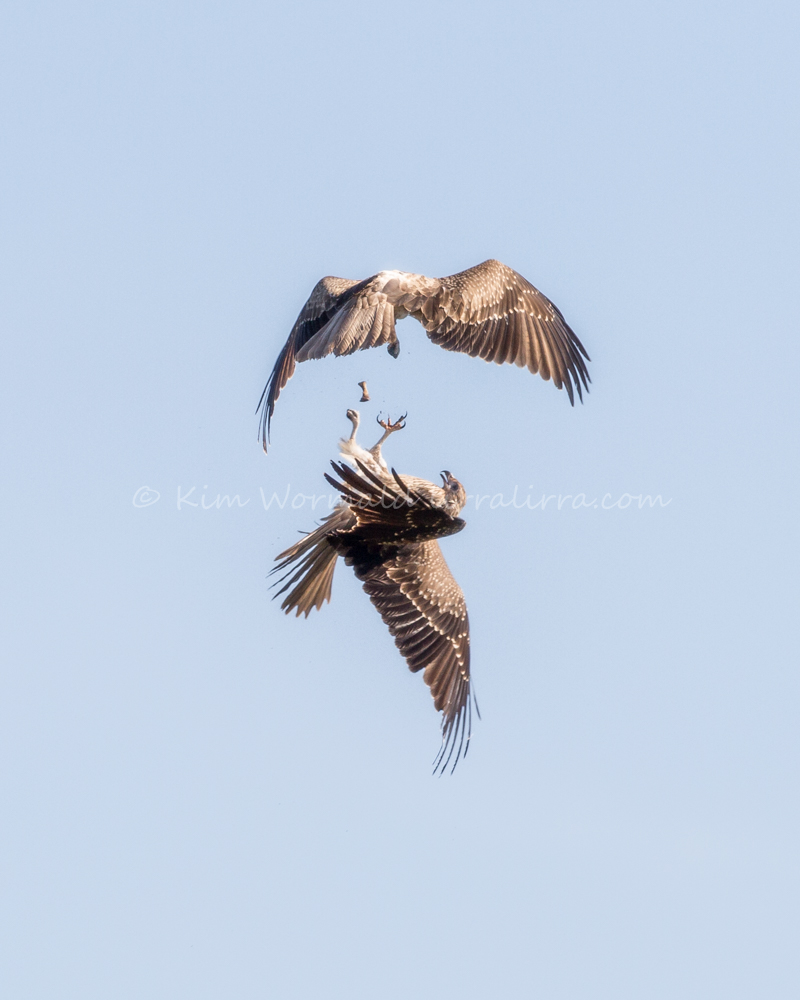
Whistling Kites (Haliastur sphenurus)
Canon 5DIII, Canon 100-400mm L IS USM II, 1/1600, f/5.6, ISO 400, focal length 400mm
I’ve watched raptors transferring food in mid-air but this Whistling Kite behaviour seemed less focussed on the actual transfer, and the bone certainly isn’t food. My taxidermy friend believes the bone could possibly be a rabbit femur.
I have several images of these kites playing with the bone, including the second bird attempting to catch it and images where the bone has been missed and is falling to the ground. The birds played together for over twenty minutes. I also have images of one of the birds carrying something that could be carrion or a clump of mud (I hope to work that out soon), and another that shows one of the kites carrying a long-stemmed flower or seed-head in its bill.
A friend who conducts regular surveys for Birdlife Australia and has birded in many urban and extremely remote locations has not seen behaviour like this and he sent the image to various experts for their opinions. The only similar behaviour reported related to anecdotal evidence of something similar between Little Eagles. Whistling Kite are known to engage in aerial acrobatics and mock fights.
During the past few weeks I have read numerous articles that discuss the aerial transfer of food between raptors, for reasons that include bonding rituals and feeding young: I have watched birds aerially transfer food and ‘fight’, it’s always a delight to watch. Whistling Kite don’t need to be particularly agile in flight as they take most of their food from the ground, apart from occasionally hawking large insects. Their diet differs across the country but carrion always features highly as do young rabbits and rodents.
Whistling Kite are about 50-60cm tall with wingspans between 1.2 metres to almost 1.5 metres; females are larger than males. They are found across Australia apart from a patch in central Western Australia that extends into south-western South Australia.
My theory is that these are immature Whistling Kite, due to the spots on their wings and heavy streaking on their underparts, and that they are having fun while bonding and honing their flying skills – please let me know if you have seen or have images of anything similar, or if you have another explanation for the behaviour.
Happy birding, Kim
Update on the Victorian duck shooting season
- SBS 2 “The Feed” aired a segment on 6 April 2016 called The Duck Shooting Debate. They show distressing footage and cover both sides of the debate. Shooters call themselves ‘the true conservationalists’ and call the killing of our native birds a ‘hobby’ and ‘recreation’. Professor Kingsford, Australia’s leading waterbird expert, expresses concern about the decline in waterbirds of up to 70% and states that he’s worried about our ‘knowledge to adequately support [the] argument that we’re sustainably managing duck populations.’ Laurie Levy, CADS, continues to inspire generations of environmentalists. Laurie said that with 450,000 ducks shot during the 2015 season in Victoria that it “must be having a major impact on local populations of native waterbirds”.
- Thomas King, Young Victorian of the Year, speaks out clearly and compassionately against the shooting season. Thomas’ excellent article, as recorded in The Guardian, can be read here: Duck Shooting is not a sport, it’s government sanctioned slaughter – Thomas King – Good on you Thomas!
- An exquiste Banded Stilt was one of thousands of birds shot last weekend. It was caught by CADS people while it flapped pathetically in shallow waters; sadly it’s injuries were severe and it did not survive. A while ago I was thrilled to capture images of a similar delicate, long-legged species, they look nothing like a ‘game’ ducks, check this link, they are beautiful birds: Black-winged Stilt
- Today’s late news is that the east side of Lake Toolondo has been closed to shooters due to the large number of endangered Freckled Duck – many of which were illegally shot two weekends ago. I hope the horrendous sounds associated with duck shooting don’t cause the species to fly into danger at the other end of the lake. Hopefully the entire lake will soon be closed – many thanks to the Coalition Against Duck Shooting and Animals Australia for taking the issue to the Supreme Court!
If you’d like to add your voice to thousands of other compassionate environmentalists please contact your MP and/or add your name to (and share) these petitions:
Ban Duck Shooting – ALV petition to Victorian Premier Daniel Andrews
Ban Recreational Duck Shooting – AA petition to add Victoria to the list of states that have already imposed a ban
~ Thank you for visiting and commenting
~ If you would like a weekly email letting you know that lirralirra has been updated please use the ‘subscribe’ box above right
~ If you care about birding ethics you might be interested in the facebook group Ethical Bird Photography
