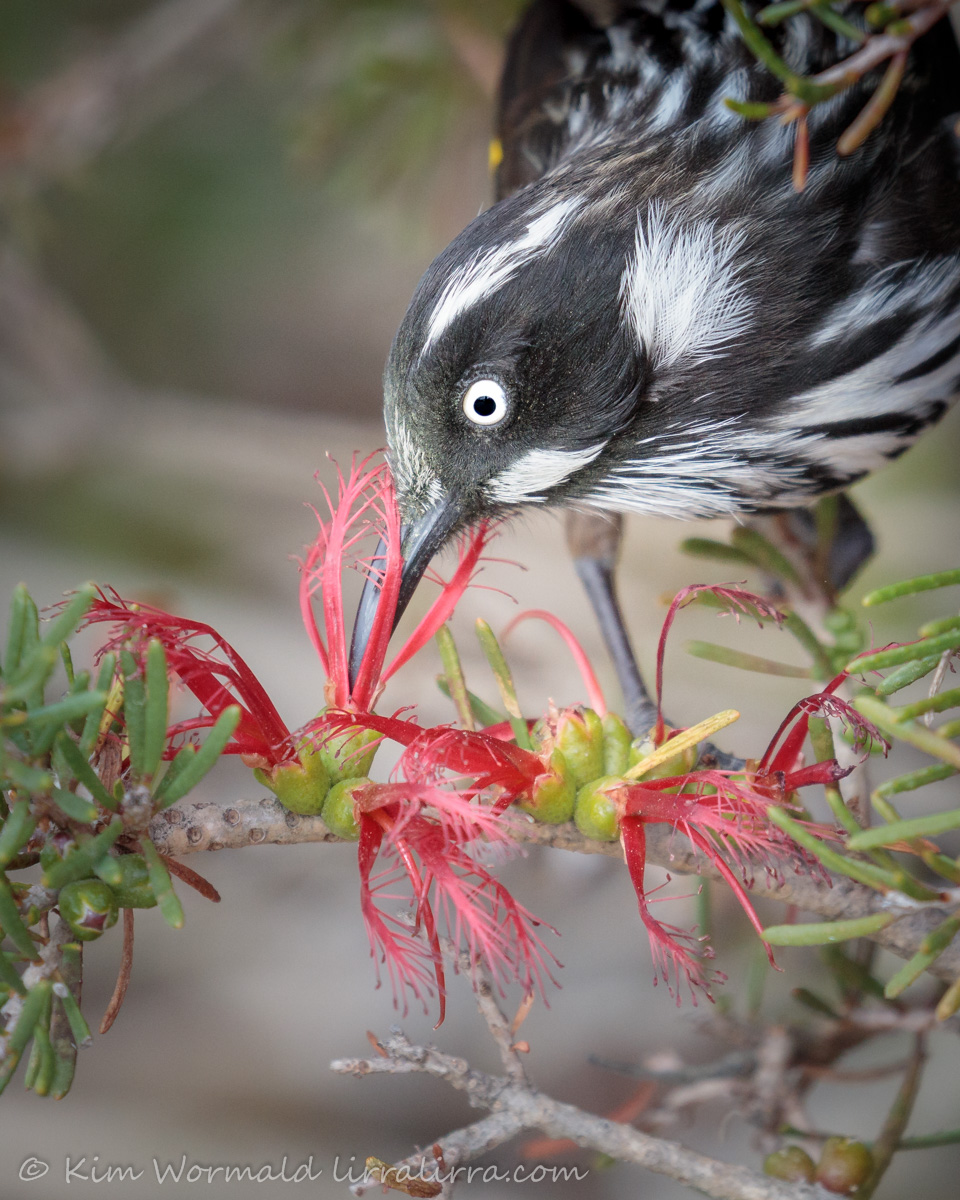
Helmeted Honeyeaters on the rise

There are now three times as many Helmeted Honeyeaters as there were in 1989 when the population reached a critical level of 50 individuals and the recovery program was established.


Helemeted Honeyeater - Kim Wormald

Helmeted Honeyeater (Lichenostomus melanops cassidix)
1/500, f5.6, ISO 6400, focal length 400mm


As one of the team of feeders involved in the supplementary feeding program at Yellingbo I get the opportunity to see this critically endangered species far more often than I see non-endangered Yellow-tufted Honeyeaters. The first time I saw yellow-tufted it was funny, they are so tiny and much less flamboyant than their showy, helmeted cousins.

The image above was taken with an ISO of 6400. For non-photographers the ISO setting relates to how much light gets through to the sensor and I rarely get an image as clear as this when I’ve used a high ISO, in fact I usually wouldn’t go higher than 1600 for fear of introducing too much digital ‘noise’ to the image. In the bush at Yellingbo the lighting is often challenging for photography and my aim is not to get good images of the birds but to get identifiable shots of their leg bands. The bands we’re most interested in are on the birds’ right foot, this bird is affectionately known as ‘white over yellow’. Sometimes we need to check the bands on the left leg too, these bands relate to which part of the reserve they were hatched in. Every time I check my heho images I have shots of legs only, sometimes I’ve chopped off the bird’s head or wings as I focus on trying to identify the bands.


Helmeted Honeyeater 3 - Kim Wormald

Helmeted Honeyeater (Lichenostomus melanops cassidix)
1/1000, f5.6, ISO 1600


Hehos often hide their bands and it can take us quite a while to identify individuals. This bird’s right legs bands are hidden but the left bands can be seen, including the green band tucked up amongst its feathers which indicates a bird that was hatched at green site. I particularly like this image and might try it in a competition one day.


Helmeted Honeyeater 4 - Kim Wormald

Helmeted Honeyeater (Lichenostomus melanops cassidix)
1/1250, f5.6, ISO 3200


At this time of year the hehos are beginning to think about breeding, with the earliest breeders starting their nests in August. They can be aggressive towards each other when breeding pairs are deciding where to nest and begin to vigorously defend their territories. I bet you know this bird’s name, though you might not realise you need to specify ‘light blue’ and in some lighting conditions ‘white’ and ‘light grey’ are horribly difficult to distinguish from each other.


Helmeted Honeyeater 5 - Kim Wormald

Helmeted Honeyeater (Lichenostomus melanops cassidix)
1/1000, f5/6, ISO 1600


I like the expression on this bird’s face as it pauses for a second to check what’s happening; ie is food about to be served or is a rival bird invading its territory, or both.

Friends of the Helmeted Honeyeater have recently recruited new volunteers to help with the supplementary feeding program but there are still a few spaces to fill. If you would like to learn more please let me know or contact the group. There’s no guarantee you’ll see hehos at every feed, there’s no guarantee that the weather will be reasonable, but the feeding areas are beautiful and every time we feed, something fascinating delights us (leeches are not in that category!).

This week’s post has been delayed as my eldest daughter is unwell, if you believe in prayer or healing energy, please think of her, thank you.

Happy birding, Kim


~ Thank you for visiting and commenting

~ If you would like to join subscribers who receive a weekly email letting them know that lirralirra has been updated please use the ‘subscribe’ box above right